
The Alignment Trap: Why Doing Things Right Matters More Than Doing the “Right” Thing

In software development, we often hear that our work must be “aligned with the business”.
It makes sense. If we’re building the wrong thing, even perfect execution won’t save us.
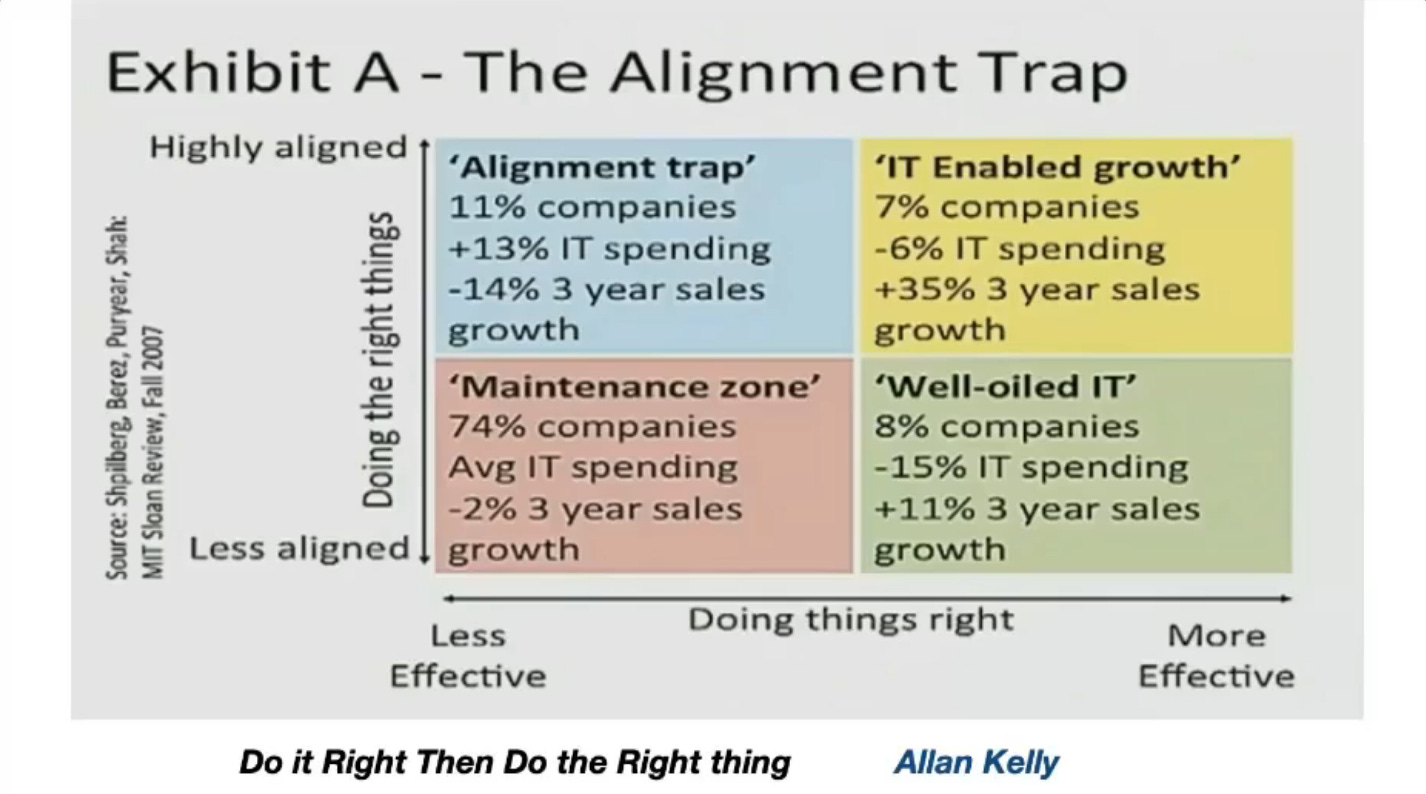
But research shared by Alan Kelly (based on work at MIT Sloan) highlights something that’s not so intuitive: teams that execute well often outperform teams that are perfectly aligned but struggle to deliver.
That idea deserves attention, especially if you care about growing as a developer.
Alignment vs. Effectiveness
The research evaluated IT departments along two dimensions:
Alignment — Are they working on what the business considers important?
Effectiveness — Are they good at delivering the work they take on?
In simpler terms:
Are you doing the right things?
Are you doing things right?
You would expect the best outcomes to come from teams that are strong in both. And that’s true.
What’s surprising is what happens in the “mixed” cases.
Teams that were effective but not perfectly aligned often performed better than teams that were aligned but ineffective. In some cases, teams that were aligned yet poor at execution performed worse than teams that were neither aligned nor effective.
This situation — being focused on the “right” goals but lacking the ability to deliver reliably — is what’s called the Alignment Trap.
Why Alignment Alone Isn’t Enough
When a team is aligned but ineffective, it creates a dangerous illusion.
Everyone agrees the priorities are correct. The roadmap makes sense. The stakeholders are satisfied with the direction.
But delivery is inconsistent. Quality is uneven. Estimates are unreliable. Technical debt accumulates. Refactoring feels risky. Releases are stressful.
Instead of improving how the team works, the typical reaction is to increase pressure. The work is important, so the team just needs to push harder.
The problem is that pressure does not fix weak practices.
If testing is poor, more urgency won’t improve quality.
If reviews are superficial, more deadlines won’t improve design.
If the build pipeline is fragile, more motivation won’t make it stable.
Alignment without effectiveness often leads to frustration rather than results.
Why Improving “How” Is Harder Than Improving “What”
Changing what a team works on is often relatively straightforward. Priorities shift. Strategies evolve. Roadmaps get rewritten.
Changing how a team works is much harder.
It touches habits, identity, and pride. Conversations about coding standards, testing discipline, refactoring, or review quality can become surprisingly emotional. People feel judged. Experience gets questioned. Comfort zones get disturbed.
As a result, many teams focus on alignment discussions because they are safer. It feels productive to debate priorities. It’s less comfortable to admit that the team’s delivery habits need improvement.
But without strong execution, alignment doesn’t create sustainable performance.
What This Means for Junior Developers
If you’re early in your career, you might not influence strategic alignment at all. You probably don’t choose which features get built or which market the company targets.
That’s fine.
Your growth does not depend primarily on alignment. It depends on effectiveness.
If you consistently improve how you work — writing clearer code, thinking about edge cases, asking for feedback, testing thoroughly, understanding trade-offs — you are building durable skills.
Even if the product direction changes.
Even if a feature gets cancelled.
Even if the company pivots.
Execution skills transfer. They compound. They make you reliable.
And reliability is what earns trust.
Over time, trust is what gives you influence. Influence is what allows you to shape alignment discussions later in your career.
Avoiding the Trap
Teams that avoid the Alignment Trap don’t ignore alignment. They simply recognize that effectiveness is the foundation.
They invest in:
Clean, maintainable code
Meaningful code reviews
Automated testing
Continuous integration
Short feedback loops
Regular reflection on how they work
Because when execution is strong, adjusting direction becomes easier. You can change what you build without chaos. You can respond to feedback without breaking everything.
It’s far easier to change the destination than to rebuild the engine mid-flight.
The Takeaway
Alignment matters. But it is not enough.
If you have to choose where to invest energy first — especially as a developer — invest in becoming effective.
Learn to deliver consistently.
Learn to improve your craft.
Learn to reflect on how you work.
In the long run, teams that are good at execution can correct their direction. Teams that lack execution struggle no matter how clear their direction appears to be.
And for junior developers, that’s an encouraging message:
you can’t control the company strategy, but you can control your craftsmanship.
That’s where real leverage begins.